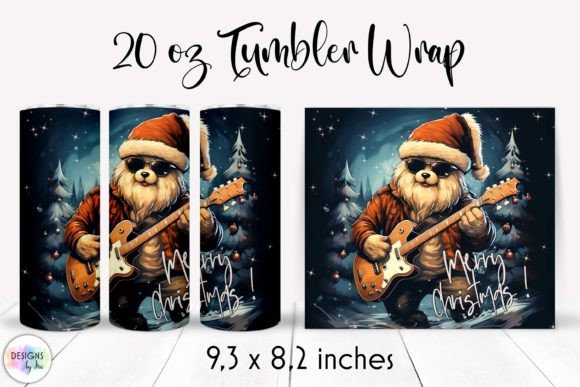
Christmas Rock Bear Tumbler Wrap Design
A Designer’s First Look: Bold, Playful, and Unapologetically Festive
When I opened the Christmas Rock Bear Tumbler Wrap Design, my first thought wasn’t “cute holiday bear”—it was “this thing has *attitude*.” The ROCKSTAR BEAR leans into the rock motif with swagger: guitar-shaped ears, a subtle lightning bolt in the background, and that bold “Merry Christmas” rendered in thick, confident lettering. It’s not delicate or dainty—it’s built for visibility. At 9.3 × 8.2 inches and 300 dpi, it’s sized for a 20 oz straight tumbler, but as an embroidery designer, I immediately saw its potential beyond drinkware: think oversized tote bag panels, front-of-sweatshirt statements, or even a playful apron centerpiece.
How It Translates to Real Embroidery Projects
I tested the Christmas Rock Bear Tumbler Wrap Design on a medium-weight cotton twill tote—no tumbler involved—and the energy held up beautifully. The bear’s facial features are simplified but expressive enough to read clearly at stitch scale; the “Merry Christmas” text avoids overly thin serifs, which means less risk of thread breakage or lost detail in satin stitch. As a machine embroidery design, it would work well for sweatshirt embroidery (especially on crewnecks), baby embroidery on soft fleece blankets, or embroidered patch production—if digitized properly from the PNG source.
For Etsy sellers and small shop owners, this is a strong candidate for holiday-themed bundles: pair it with a coordinating “Rockin’ Around the Tree” tea towel design or use it as the hero motif on a limited-run holiday apron line. Its personality helps handmade products stand out in crowded digital marketplaces—not because it’s flashy, but because it feels intentional and cohesive.
Where It Shines—and Where You’ll Want to Pause
The Christmas Rock Bear Tumbler Wrap Design excels on stable, medium-to-heavy fabrics: canvas, denim, structured knits, and quilting cotton. On those surfaces, the composition holds its shape, and the visual weight matches the stitch density you’d naturally apply. It’s also highly effective for custom apparel where brand voice matters—think a local coffee roaster’s holiday merch or a music teacher’s studio gift set.
But caution applies in a few real-world scenarios. Because it’s delivered as a high-res PNG—not an SVG or embroidery file—you’ll need to digitize it yourself or hire a digitizer before stitching. That means extra time and cost if you’re not equipped for vector conversion and stitch mapping. Also, avoid using it directly on stretchy fabric (like ribbed knit caps) or ultra-thin materials (such as lightweight muslin) without significant redesign: the original layout assumes flat, rigid placement, and curved surfaces like hat fronts will distort proportions unless adjusted.
Small hoop sizes (under 5×7 inches) won’t accommodate the full design without scaling down—and shrinking risks muddying the lettering and losing the bear’s signature edge. Likewise, dark fabric backgrounds demand careful thread color planning: test black-on-navy or charcoal-on-forest green mockups before committing. And while the design reads well digitally, remember that dense fill areas (like the bear’s torso or guitar outline) may require stronger stabilizer backing to prevent puckering on softer textiles.
What This Means for Your Finished Product
When stitched well, the Christmas Rock Bear Tumbler Wrap Design elevates perceived value—not just because it’s festive, but because it signals confidence in execution. Customers respond to clarity and character, and this design delivers both. A personalized gift featuring it feels curated, not generic. A boutique product with this motif communicates brand personality instantly: fun, inclusive, and unpretentious. For craft business owners, that translates to higher buyer engagement and repeat interest—especially during November–December when shoppers seek standout holiday embroidery.
That said, professionalism hinges on execution. If stitching is rushed or poorly stabilized, the rock-and-roll vibe becomes “rock-and-roll *regret*.” So don’t skip the fundamentals: test on scrap fabric first, check thread color contrast in natural light, review stitch density against your fabric’s weight, and confirm your hoop size can handle the full layout—or plan for smart cropping.
Practical Notes Every Embroidery Designer Should Keep Handy
- Always digitize from scratch—this is a PNG, not a ready-to-stitch embroidery file. Don’t assume auto-trace tools will preserve the design’s rhythm.
- Inspect small details closely: the lightning bolt and guitar curves need clean vector paths to avoid jagged edges in satin stitch.
- Test in black and white mockups to verify legibility—some holiday designs fade into noise on busy backgrounds.
- Compare light and dark fabric backgrounds before finalizing thread colors; reds and metallics behave differently on black vs. cream.
- Use cutaway or tear-away stabilizer appropriately—medium-weight cutaway works best for dense areas, especially on knits.
- Confirm licensing terms before selling finished items or bundling this as part of a commercial embroidery kit. Since it’s labeled as a Graphics product, clarify usage rights with the seller.
- Consider its versatility beyond tumblers: it’s equally effective as a tote bag design, pillow cover focal point, or embroidered patch base—if adapted thoughtfully.
Final Thought: A Design That Earns Its Spot
The Christmas Rock Bear Tumbler Wrap Design isn’t just another holiday graphic—it’s a mood, a message, and a practical asset rolled into one. It doesn’t try to be everything; it owns its niche: joyful, energetic, and unmistakably *now*. For embroidery designers, Etsy sellers, and small shop owners building authentic handmade product lines, it’s a smart addition—if treated with the care it deserves. Use it right, and it won’t just decorate a tumbler or tote. It’ll start conversations, spark smiles, and quietly reinforce why customers choose handmade over mass-produced. That’s not just good design. That’s good business.