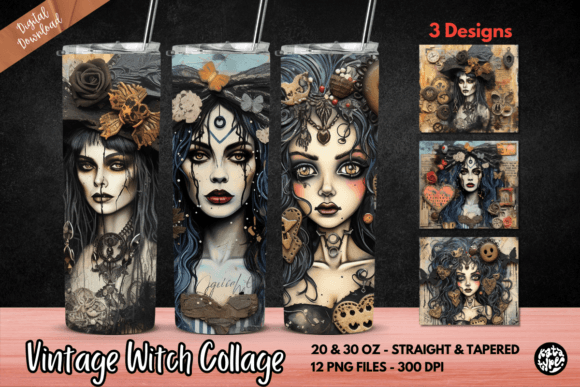
Vintage Witch Collage Tumbler Wrap
First Impressions: Whimsy with Wearable Weight
Opening the Vintage Witch Collage Tumbler Wrap files, I immediately felt that familiar designer pause—the kind that happens when a design lands just right in your gut. It’s not overly spooky or cutesy; it’s layered, nostalgic, and quietly confident. Think ink-stained botanical sketches, delicate script labels (“Potion No. 7”, “Midnight Brew”), tiny crescent moons, and hand-drawn cauldrons—all arranged like a curated apothecary shelf. The collage layout feels intentional, not cluttered. That matters—especially when translating to embroidery, where visual hierarchy dictates stitch clarity and wearability.
A Real Project Test: Embroidering a Linen Apron for a Local Herb Shop
Last week, I used one of the three designs from the Vintage Witch Collage Tumbler Wrap as the centerpiece for a custom linen apron—part of a small-batch order for a neighborhood herbalist. I chose the 20 oz. straight version (scaled down slightly) and digitized it into a machine embroidery design with balanced satin stitch borders, open fill stitch areas for breathability, and subtle running stitch accents for texture. The result? A finished product that looked handmade *without* looking fragile. Customers at the shop’s weekend market stopped mid-aisle—not because it screamed “witchy,” but because it felt *authentic*, tactile, and thoughtfully placed.
Where This Design Truly Shines
- Embroidered tote bags: The composition holds up beautifully on wide, flat surfaces—no awkward cropping or lost details near seams.
- Sweatshirt and crewneck embroidery: Its moderate height-to-width ratio avoids distortion across curved shoulders or ribbed cuffs.
- Applique designs for baby items: Soft edges and clear negative space make it ideal for gentle fabric layering—no tiny floating elements that snag or unravel.
- Patches and pillow covers: Each of the three motifs works independently if cropped, giving flexibility for smaller hoop sizes or modular product lines.
- Holiday and boutique merchandise: It reads as seasonal without being dated—perfect for October through January gifting, especially paired with natural fibers and muted thread colors.
Use With Care: Practical Limits You’ll Notice Mid-Stitch
The Vintage Witch Collage Tumbler Wrap isn’t built for every surface—and that’s honest, not limiting. Here’s where I slowed down and adjusted:
- Curved surfaces like caps or tapered tumblers: The tapered PNGs help, but embroidery on rigid curves still demands careful hooping and stabilizer choice—test first on scrap denim or twill.
- Thin or stretchy fabrics: Delicate lettering and fine line work can blur if tension isn’t dialed in. Use cutaway + tear-away combo stabilizer, especially for lightweight cotton or rayon blends.
- Dark fabric backgrounds: Some lighter-toned elements (like chalky script or pale florals) lose definition unless you boost thread contrast—try charcoal grey or deep plum instead of stark white.
- Frequent-wash items (tea towels, baby bibs): Avoid overloading dense fill stitches in high-friction zones. Simplify background textures if durability is priority over illustration fidelity.
How It Shapes Perception—Beyond Just Stitching
This isn’t just about whether the design embroiders cleanly—it’s about how it makes your customer *feel*. The Vintage Witch Collage Tumbler Wrap elevates a simple embroidered patch into something collectible. It signals care in curation, not just execution. For Etsy sellers, that translates directly to higher perceived value and fewer “Is this handmade?” questions. For craft fair vendors, it helps products stand out without shouting—especially next to mass-printed alternatives. And for boutique branding? It layers personality onto functional items (aprons, totes, tea towels) in a way that feels cohesive, not costumed.
Designer Notes You’ll Want Before Threading Your Needle
- Test the design on scrap fabric *in your actual production setup*—thread brand, needle size, and machine model all affect how fine lines render.
- Review stitch density visually: zoom in on PNGs to spot tightly packed areas that may benefit from slight simplification in your embroidery file.
- Confirm hoop size compatibility early—some versions fit comfortably in a 5x7 hoop, others need 6x10 or larger for full fidelity.
- Inspect small details like dot accents or serif ends—they’re charming on screen but may vanish on coarse linen or terry cloth.
- Run black-and-white mockups: this design relies on tonal contrast more than color, so grayscale previews reveal clarity issues fast.
- Check licensing before selling finished products—since this is a digital embroidery file within the Print Templates category, commercial use terms must be verified with the creator.
Final Thought: A Design That Works *With* Your Process
The Vintage Witch Collage Tumbler Wrap doesn’t ask you to force it into your workflow. It invites thoughtful adaptation—whether you’re stitching a single personalized gift or building a seasonal collection for your craft business. It’s detailed enough to reward close looking, but generous enough in spacing and rhythm to stay legible after dozens of washes. As a designer who’s reviewed hundreds of digital embroidery files, I keep returning to this one—not because it’s flashy, but because it *lands*. It fits real hands, real fabrics, and real customers who choose handmade because they value intention over impulse. That’s rare. And worth holding onto.