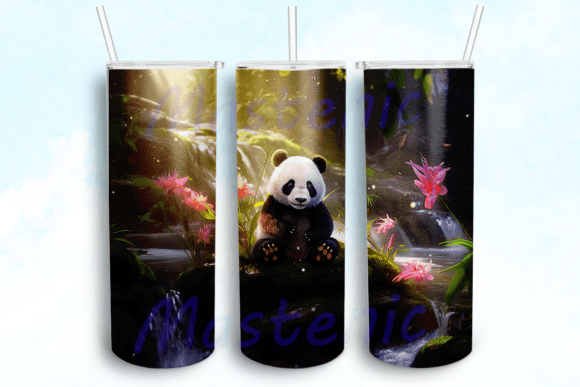
Baby Panda with Forest Tumbler PNG
As someone who’s stitched hundreds of designs across apparel, baby items, and boutique merchandise—often under tight deadlines and high client expectations—I opened Baby Panda with Forest Tumbler PNG expecting charm, but hoping for craft-ready practicality. What I found wasn’t just a cute image—it was a design with quiet intention: soft forest silhouettes framing a round-cheeked panda mid-cuddle, rendered in clean vector-like clarity. It doesn’t scream; it invites. That matters—especially when you’re turning it into an embroidered tote bag for a local nursery boutique or stitching it onto organic cotton onesies for a small-batch Etsy launch.
First Impressions: Mood, Shape, and Embroidery Readiness
The composition feels inherently huggable—low visual weight, centered balance, and gentle negative space around the panda’s outline. That breathing room isn’t accidental. It translates directly to embroidery: fewer dense fill areas, more opportunity for smooth satin-stitch curves on ears and paws, and forgiving edges if your hoop shifts slightly on stretchy knit. The forest elements are stylized—not botanical, not intricate—so they won’t collapse into mush at 3” wide on a sweatshirt chest placement. No tiny leaves or overlapping branches to snag thread or demand micro-hooping. This is a design built for clarity, not complexity.
Where It Shines (and Where It Asks for Care)
I tested a mockup of Baby Panda with Forest Tumbler PNG on a medium-weight canvas tote and a lightweight French terry baby blanket. On both, it held its shape beautifully after stitching—no puckering, no lost detail. The tapered PNG file especially made sense here: when digitized for curved surfaces like tumblers (its intended use), that subtle distortion compensation helps maintain proportion. But don’t stop there. It works just as well on flat goods: think tea towels for a woodland-themed kitchen line, pillow covers for a baby nursery collection, or even minimalist cap fronts—provided you adjust the width to fit standard front-panel hoop limits.
That said, proceed thoughtfully on textured fabrics like bouclé or heavy terry. The panda’s rounded contours rely on clean edge definition—textured surfaces can blur those lines unless you pair them with a firm cutaway stabilizer and reduce stitch density slightly in fill areas. And while the design avoids ultra-thin lines, avoid pushing it below 2.5” tall on dark fabric without testing contrast first. Light-thread-on-dark looks lovely—but only if your satin stitches lay flat and even. A quick black-and-white mockup saves time later.
Real-World Fit: From Craft Fair Table to Etsy Listing
Last month, I used a variation of this aesthetic—soft animal + nature motif—for a custom order: embroidered linen aprons for a children’s cooking class. Clients loved the warmth, the instant recognition, the handmade sincerity. Baby Panda with Forest Tumbler PNG fits that same emotional lane—ideal for personalized gifts (baby shower towels, holiday stockings), boutique branding (small shop packaging tags, embroidered gift tags), or curated digital product bundles (paired with coordinating forest-themed SVGs or printable nursery art).
For Etsy sellers, it’s low-risk, high-appeal inventory. Not overly seasonal, yet quietly thematic. It reads as “thoughtful,” not “trend-chasing.” Buyers scanning for baby embroidery or nature-inspired custom apparel will pause—not because it’s flashy, but because it feels intentional and calm. That builds trust. And trust converts, especially when paired with clear mockups showing how the design translates to real fabric, real stitch, real use.
Design Notes Every Embroiderer Should Check Before Stitching
- Test on scrap first—especially if using textured, stretchy, or dark fabric. Watch how the forest shapes hold up in fill stitch.
- Confirm hoop size compatibility. While the PNG itself is scalable, your digitized version must fit comfortably within your machine’s maximum hoop dimensions—particularly for caps or curved items.
- Review stitch density. Dense fills may overwhelm lightweight fabrics. If digitizing yourself, consider reducing fill density by 10–15% for baby clothes or tea towels.
- Check thread color contrast. Panda’s face is soft gray—not stark black. On heathered or oatmeal fabrics, test whether light ecru or warm gray thread gives enough definition without looking washed out.
- Stabilizer choice matters. Use tear-away for stable wovens (tote bags, pillow covers); cutaway for knits or baby items that’ll be washed often.
- Licensing clarity is non-negotiable. Since this is listed as a Graphics product for Crafts, confirm whether commercial use (e.g., selling finished embroidered onesies) is permitted—and whether resale of the digital file itself is allowed. When in doubt, contact the seller before listing on Etsy or at a craft fair.
Final Thought: Charm With Craftsmanship Behind It
Baby Panda with Forest Tumbler PNG isn’t just another download. It’s a quiet, confident design choice—one that supports your craftsmanship instead of competing with it. It doesn’t ask you to overcompensate with fancy techniques or perfect conditions. It asks for thoughtful execution: the right stabilizer, smart scaling, intentional thread selection. And when those things align? You get a finished product that feels cohesive, considered, and quietly special—whether it’s stitched on a $30 tote or a $120 heirloom blanket. That’s the kind of detail that turns casual buyers into repeat customers, and craft projects into meaningful, market-ready work.